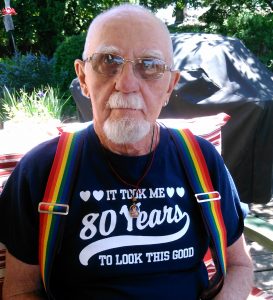
An Older Gentleman (Again)

At age 83 some might refer to me as “an older gentleman,” a generous euphemism for “an old man.”  The expression seems to convey respect.  As if by merely surviving seventy years plus I earned respect.  Growing old makes me no more a candidate for respect than being tall, short, female, male or myriad human appearances and circumstance.  Hanging on into your seventies is luck, making not too many dumb choices, and genes.

Scoundrels, tramps, thieves, crooks, liars, rapists and murderers are proportionally represented among octogenarians as the general population.  If a John Dillinger, Al Capone, the Zodiak Killer, Ted Bundy, Gary Ridgway or Jefferey Dahmer survived past seventy would they have earned respect?  How about Joseph Stalin and Adolf Hitler?

For some, respect seems natural.  Not by dint of age or physical characteristic, but for helping to make this struggle, this human life, a little easier.  Peacemakers, Healers, Jesus Christ, The Buddha, great scientist and artists, Socrates, Aristotle, Mohandas Ghandi, Nelson Mandela, Reverend Martin Luther King, Jr. deserve respect.

But how about the rest of us?  How about a toddler in a swing, a teen hunkered over a laptop, a high school dropout, a high school graduate, a retiree making ends meet flipping burgers as Mickey D’s, twenty-somethings starting a family, working moms, working dads, sanitation truck drivers, eighteen-wheel drivers, farmers, migrant workers, the homeless and imprisoned?  Every human deserves no less respect than an older gentleman.

Respect aside, youngsters seeing “an older gentleman” or matron may feel a not-exactly-conscious curiosity.  “What’s it like?  How does it feel?  You look old.  Do I want to go there?”  As memory serves, Dr. Murray Banks answers, “You may say, ‘I don’t want to live past ninety.’  You’ll say it ‘til you’re eighty-nine.”

Teaching respect has evolved.  Until five or so decades back, kids were explicitly taught respect.  “Do as you’re told.” “Don’t talk back.”  “Don’t sass.”  Curious words “sass,” never hear it today.  Cloaked under contemporary culture and adolescence independence, most of today’s kids pick up respect.  It has to be adult modeling.  We’re doing something right.  Only a small subset of today’s youngsters are blatantly disrespectful; they were there all along.

In my view, as respect’s spotlight dimed, for some dis-respect “diss”ing lit up.  Curiously, gangs and individuals with little are no respect for others take affront at being “dissed.”  It goes much further.  Nations dissing others is war.  If nations learned respect, if they stopped dissing, we would have a far more happy, peaceful world.

Like many words I toss out without knowing what I’m talking about, “respect” comes down to definition, to etymology: “re-back” plus “specere–to look at,” to look back, to see again!  To re-spect people, I must see them again!   Amid the incomprehensible complex mix of genes and environment, amid the physical and emotional suffering, I must continually remind myself, “There but for the grace of God go I.”

Despite mindboggling complexity, the human equation has common denominators.  In secret, we all know them.  If I see through the straw person I crate to the wounded child inside, if I’m not fooled by your charades, your defenses, if I see that we are all wounded, yearning for kindness, for love, not to be hurt, this human existence, this life, would be better indeed.

Older gentlemen deserve respect.  So do you.  So do we all.

The Biggest Fraud In History

In a November 29 interview* with Fox News anchor Maria Bartiromo, President Trump pronounced America’s 2020 Presidential election,
     the greatest fraud in the history of our country, from an electoral stand point.
     And I guess you could build it up bigger than an electoral standpoint—what’s
     bigger from an electoral standpoint?  What is bigger than that?

Among a laundry-list of unsubstantiated allegations, Donald would “like to file one nice, big, beautiful lawsuit, talking about this and many other things, with tremendous proof.”

Great!  Do it!  If Judges won’t listen, Mr. President, take it to The People.  File your Brief on the Internet.  But, be specific!  Show us your “tremendous proof”: evidence, documents, testimony, depositions, affidavits.  Anyone can allege anything Donald, but successful litigation hinges on facts!  Rudy knows that. Or does he?

America and the World are witnessing a textbook case of “Malignant Narcissistic Personality Disorder” confounded by delusional ideation and profound Paranoia.  The implications are alarming!  Pray that stable minds manage The Store until January 20.

*CNN Editor-at-large Chris Callizza offers an item by item fact check of Trump’s latest rant: https://www.msn.com/en-us/news/politics/the-40-most-utterly-unhinged-lines-from-donald-trump-s-first-post-el

Balsa-wood Gliders

I love little balsa-wood gliders,
the kind we used to buy for a nickel
and how cost a quarter
or fifty cents.

It seems like magic when they
pause in the air
and dive
and swoop
and glide
and settle silently to the grass
like a leaf
or a feather.

Little balsa-wood glider make me feel very good inside.

I am very glad God made
little balsa-wood gliders
and air
to glide in
and kids
to throw them.

Live Theater II

Life’s but a walking shadow, a poor player
That struts and frets his hour upon the stage,
And then is heard no more.  It is a tale
Told by an idiot, full of sound and fury,
Signifying nothing.
Macbeth, Act V, scene v
William Shakespeare

Morose sentiment notwithstanding, the corpus of he who penned these lines is testament to a profound conviction in Life’s significance!  Still, as always, the Bard is spot on.

With props, “business,” and dialog Theater tells a story.  Live Theater uses props, business and dialog.  What’s the story?  

In no small measure props, our “Stuff,” sofas, chairs, tables, clothes, BMWs and Kias, desktops and laptops, cell phones and TV’s, Airliners, locomotives and International Space Stations, define us!

And the “busy-ness!”   We are busy.  Scurrying, speeding, scheming, working, playing, fighting, killing, rarely still.  Blaise Pascal wrote, “All of humanity’s problems stem from man’s inability to sit quietly in a room alone.” 

Finally, the piece driving Live Theater’s comedy and tragedy, dialog!  We talk, inside and out loud.  We continually chatter.  And we write.  Worldwide, written dialog overflows bookstore and library shelves.  Robert Service wrote, “The Devil grins at these seas of ink I splatter.  God forgive my literary sins.  The other kind don’t matter.”  I like to think writing is my greatest sin.  

Props, business, dialog, but what is Live Theater’s story?  What  hides in plain sight on the chairs and sofas, beneath the strutting and fretting, amid the continual chatter, the sound and fury?  What did Shakespeare and even poor Macbeth know?  What do actors, actresses, artists in all medium work so hard to capture?  What vital, perhaps-too-often-unnoticed piece drives Live Theater’s Comedy and Tragedy?  What makes Live Theater not a tale told by and idiot?”  What makes it worth the price of a ticket?

People matter!  Human Relationship drives Live Theater’s push and pull, confusion and conflict, agony and ecstasy, love and, yes, hate.  What matters, really matters, and is, perhaps ironically, the wellspring of my happiness is your happiness.  Loving you almost as much as my own dear self.

Human Relationship makes Live Theater worth watching and life worth living!

Who Do Ya Trust?

Four years ago, he rejected unanimous National Security Agencies’ findings that Vladimir Putin meddled in America’s 2016 presidential election, taking Pal Vlad’s word he didn’t meddle and his election was valid.  Today, he rejects across-the-board agreement America’s 2020 presidential election was the most secure in history, insisting without a kernel of evidence, this time it was “Rigged,” from inside!  Go figure?

See How If Feels Revisited

It’s said, debate arose among Churchmen of Medieval Europe regarding the native language of man.  Greek or Latin?  When prayer, the study of scripture, Plato and Aristotle failed to address their question, the learned Clergy devised a scheme which, a millennia before the Renaissance, became a hallmark of Science: an experiment.

A group of newborns was isolated as never to hear human speech. Anticipating what researchers would label “extraneous variables,” the subjects would be fed, diapered and clothed but otherwise experience the barest minimum of human contact.   The hypothesis was, uncontaminated by not hearing human speech, the subject would reveal humankind’s native tongue.  The outcome was indecisive.  Their little subjects never spoke.  Denied meaningful human contact, nurturing, they
died.

A millennia down the road, economic and societal meltdown lead Bulgaria’s child welfare system to conditions eerily reminiscent of that–I hope apocryphal–Dark Age experiment.  In 2007 BBC exposed “Bulgaria’s Abandoned Children” to the world.  Vacant-eyed infants peering through steel cribs bars, rows of naked emaciated bodies nodding silently on cold plastic pots, legs barely able to support skin-and-bones frames, orphans scraping spoons in metal bowls, frantically competing for a last fragment of potato.  Overshadowed by the graphic horror of this disaster is, despite being warehoused cheek-by-jowl, total absence of physical contact, touch, talk, nothing resembling play.  Of course, the mental and emotional impact on these victims is profound.  In the “Daily Mail” Rosa Monckton reports, “Because of a lack of interaction, children in Bulgarian institutions grow slowly mad.”  With the tragedy exposed, organizations and individuals rushed to foster and adopt.

A documentary recounted the challenges confronting American families having the love and courage to take in these profoundly damaged little people.  Of many physical and emotional encounters between adoptees and adoptive parents, for me one stood out.  An out of control boy threw objects, broke pictures and mirrors, punched holes in walls.  When his desperate Mom tried to placate him the six- or seven-year-old punched her in the stomach, “See how it feels!”

For some time this ignominious act and exclamation puzzled me.  Here was a woman who, surely knowing life would be significantly impacted if not turned upside down by the gesture, knocked herself out, jumped through bureaucratic hoops and over hurdles, went to significant financial expense, and overcame unforeseen obstacles and challenges to rescuing a profoundly physically and emotionally stunted child being rewarded with a punch to the gut!  “See how it feels!”

See how what feels?  Lady in the big house, see how it feels to stare through steel crib bars for days on end.  Lady in the bed with its sweet-smelling comforter and  half-a-dozen pillows, see how it feels to lie in a moldering nightshirt on a dank mattress day and night.  Lady with cupboards, refrigerators, and freezers stocked with food to feed an orphanage for days, see how it feels to experience constant gnawing hunger, to fight over a handful of spoiled beans.  Lady on the gleaming white toilet in her antiseptic, porcelain and chrome bathroom, see how it feels to squat for hours on a plastic pot amid naked, emaciated, near-zombies swaying slowly back and forth.  See how it feels Lady!  See how it feels really to hurt!  See how it feels to suffer!

The Buddha taught life is suffering.  My life, and from my perspective other people’s, seems to bear this out.  What we do with suffering makes all the difference.  Mostly, we suck it up.  We’re Heroes.  We suffer in silence.  We’re patient.  To be “patient” is “to suffer.”  It’s why doctors have patients.  Sometimes the pain seeps out through passive-aggressive or vicarious means; we can be sneaky, mean.  A popular outlet for suffering is addiction.  To “addict” is “to assign or surrender.”  When life is too much we assign or surrender our pain to alcohol, marijuana, cocaine, heroine, work, money, success, relationship.

See how it feels is the taproot of abuse: child abuse, spousal abuse, elder abuse, colleague abuse, employee abuse.  As if through perverse, crazy thinking we feel we can be rid of suffering by giving it to someone else.  When the pain seems unbearable we punch somebody in the gut.  Sick, tired, injured, insulted, frightened or had a really bad day, some if us come home, curse, kick the dog, shout at the spouse, beat the kid.  Driven by madness some walk into a school, church or synagogue with an AK47!  See how it feels to hurt inside!

See how it feels America.  In your grand cities, with your skyscrapers, your streets crowded with cars, your sidewalks crowded with shoppers, your homes with  electric power, hot and cold running water, heating and air conditioning, see how it feels to live for generations in tents, mud huts, and refugee camps.  In your automobiles cruising streets and highways paved with asphalt stolen from beneath our feet, see how it feels to walk barefoot down rutted tracks.  In your Super Markets, shelves loaded with so much food a quarter is wasted, see how it feels to suffer from hunger, to die from starvation!   See how it feels to be marginalized, exploited, humiliated.

When we fly aircraft into your World Trade Center, see how it feels to have our city, one of the oldest on Earth, bombed without provocation, its infrastructure destroyed, its citizens murdered, leaving us in perpetual economic and cultural chaos behind!   

See How it Feels has a corollary: Misery Likes Company.  In the former case we let others, if not feel, at least know our suffering.  In the latter offers prosaic if not perverse relief in knowing others suffer.  The paparazzi and tabloids, the “National Inquirer” and others capitalize on this.  Waiting at the checkout counter, with a sick kid and spouse just laid off, about to charge another weeks groceries to a nearly maxed-out VISA, a shopper finds fleeting consolation reading of “Hillary’s Breakdown,” “The Pope’s Love Child,” “Obama’s Porno Addiction,” “Tom Cruse Dying of Aids.”

Misery Likes Company found creative outlet when, in 1935, Bill W. and Bob S. expanded peer support from church, synagogue, Elks, Rotary and Masons to the broad world of suffering.  Over ensuing decades their Alcoholics Anonymous model was adopted by folks suffering from other drug addictions, mental illness, cancer, heart disease, diabetes, suicide prevention, those impacted by suicide and violent death, grief, Mothers Against Drunk Driving, Parents of Murdered Children and more.

With all of the above said, it’s important to point out we don’t really hurt others out of malevolent intent.  Whether we suffer in silence, find relief knowing we don’t suffer alone, or beat up on the next object or person in sight, for better or worse much, if not the lion’s share, of human behavior, has unconscious roots.  We act out  of unconscious motivation, we don’t want to hurt others; we just want the suffering to stop.  Even the horrors inflicted by sociopaths are rooted in profound mentally illness.

It is important to know all is not lost.  There is hope.  One key to managing suffering, a hallmark of the Buddha’s teaching, is “Mindfulness.”  Thick Nhat Hanh is succinct, “Practicing mindfulness I can recognize what is happening in the present without grasping or aversion.  I can practice mere recognition of what is going on within me and around me without judgement or reaction. This helps me to keep stability and freedom alive within myself.” Touching the Earth (P.22)

Two and a half millennia after the Buddha, Sigmund Freud defined the purpose of psychoanalysis, if memory serves, as “to make unconscious process conscious.”  Over the ensuing century psychiatry, psychology and counselors have helped millions find, if not total, significant relief from mental and emotional suffering.  Psychiatrists Dr. Eugene Chernell and Dr. Patrick Freehill saved my life.

Eastern practices of Tai chi, Yoga and acupuncture have helped Westerners experience a mind-body connection significantly effective in relieving stress.  Today in American homes, groups, schools, and hospitals, meditation gains significant traction.  

If we screw up our courage and confront the ghosts who, for decades, have grumbled and stirred in the attic, if we are brave enough to climb the ladder, push open that little door in the ceiling and shine a light up there, what do we see?  Dust and cobwebs.  What we thought were ghosts are imaginary, parasites with no power.  The only power they seem to have is the power we choose to give them.  They never existed!

And The Fight Goes On

A hundred and fifty million ballots tallied and Joe‘s presidency secure, I determined to stop writing about America’s 2020 presidential election.  I shouldn’t be surprised that Donald’s shenanigans seduce me back to the keyboard.

Our President’s refusal to except the Will of the People has millions worldwide baffled.  For me, turning back the calendar three years demystifies this intransigence.

In The Dangerous Case of Donald Trump, three dozen mental health professionals and others with firsthand experience agree that our Man in the Oval Office exhibits clear symptoms of a “Malignant Narcissistic Personality Disorder.”  Niece and Clinical Psychologist Mary Trump’s Too Much and Never Enough How My Family Crated the World’s Most Dangerous Man backs this diagnosis from firsthand experience.

The Diagnostic and Statistical Manual of Mental Disorders (DSM5) defines Narcissistic Personality Disorder (NPD) as, “a persistent manner of grandiosity, a continuous desire for admiration, along with a lack of empathy. It starts in early adulthood and occurs in a range of situations, as signified by the existence of any 5 of the next 9 standards,”

  • A grandiose logic of self-importance
  • A fixation with fantasies of infinite success, control, brilliance, beauty or idyllic love
  • A credence that he or she is extraordinary and exceptional and can only be understood by, or should connect with, other extraordinary or important people or institutions
  • A desire for unwarranted admiration
  • A sense of entitlement
  • Interpersonal oppressive behavior
  • No form of empathy
  • Resentment of others or a conviction that others are resentful of him or her
  • A display of egotistical and conceited behavior or attitudes”

After three years of Trump, we don’t need the President of the America Psychiatric Association or Sigmund Freud to make this call. Self-importance, fixation on fantasies of greatness, feeling extraordinary and exceptional, desire for admiration, sense of entitlement, oppressive behavior, no empathy, resentment, egotistical and conceited, that’s 9 for 9 folks! Narcissistic Personality Disorder! A slam-dunk! 

DSM5 does not use “Malignant.” Campbell’s Psychiatric Dictionary describes Malignant Narcissism as combining characteristics of Narcissistic and Antisocial Personality Disorders with aggression and paranoia, making the patient not only delusional but potentially dangerous!

Identifying their roots and nature demystifies and points to the serious hazards—such complete failure to lead against COVID-19—which have arisen and continue to arise from Donald J. Trump’s behavior.  Now we see frivolous litigations leaving judges fed up.  Bullheaded refusal to cooperate with Biden’s team frustrating and complicating an orderly Presidential transition.  Holding back of essential information and intelligence leaving America, indeed the World, at serious hazard. 

Fighting Gravity

At age 83 I’m continually conscious of how much energy it takes just standing, moving.  As a boy on the farm I hauled hay, shoveled ditch, pitched manure, climbed trees, walked, and ran a lot!  I was the fastest kid in South Emery High School.  A land surveyor, I hiked Nevada and Utah deserts, climbed Alaska mountains and slogged through swamps and tundra.  If you’ve not walked over tundra, imagine hiking miles on wet mattresses.  In middle age I took up running.  Over thirty years I jogged thirty thousand miles, over 160 races, 7 marathons.  Today just plodding around the house takes determination.

I’ve been tired, even exhausted, but until now given virtually no thought to a major cause of my fatigue.  When I’m not lying down I’m fighting gravity.  It is odd that only recently I finally confronted the culprit, the ubiquitous force tugging at my heels.  Of course I knew about gravity, experienced it, but real appreciation was academic, theoretical.  Curiously, at last looking the beast in the eye raises significant issues heretofore ignored or overlooked.

Back to theory for a moment, Albert Einstein said gravity is matter bending space.  When I don’t tighten my belt and my britches fall to my knees, it’s matter bending space.  Sure Albert.  Right.

In the fight against gravity sitting ranks next best to lying–more on lying later.  We say “sit down.”  We sit.  “Down” is superfluous.  Same for “sit up.”  Don’t need the “up.”  Except for kids.  Kids sit on their knees, one leg, one cheek, they slouch.  Parents and teachers order kids to “sit up.”  Adults slouch.  I never heard an adult told to “sit up.”

“Stand up.”  Here again no need for “up.”  If we stand it’s up.  Except for the military.  When a military maneuver ends the troops “stand down.”  As opposed to “stand up” I suppose.

When I lie down I don’t fight against gravity.  Which brings me again to the up and down business.  I lie.  No need for “down.”  After countless boring hours in high school and college English, friend Phil explained lie and lay.  When I “lie” I place my body in a supine position.  I “lay” an object on a table; a chicken “lays” an egg.  Phil pointed out, however, that when I place the soft material from between a goose’s feathers and skin on a table I in fact “lay down.”  Understanding even a small piece of this lie, lay business I feel kind of smug.

You can “lay over,” but it’s not about kids or the military.  If weather or terrorists close LaGuardia your flight may “lay over” in Gander, Newfoundland–Gander, I like that name; reminds me of laying down.–  But why “lay over”?  Why not “lay up” or “lie down” in Gander?  Maybe its “lay over” because the pilot lays the aircraft on the tarmac.  Passengers and crew may spend a night “lying”–not “laying”–in a Gander hotel bed.  I heard “lay up”; don’t recall where.  

I get side-tracked, better yet bogged down, by what my Harbrace College Handbook calls “appropriate form of the verb.”  Seven pages devoted to that mind-numbing lay, lie, laid, lying laying, sit, set, sat, sitting, setting business.  I’d really like to understand, but just seeing it my eyes want to cross.  I pity the poor folks who have to think about and write it down.  After passing a fifth grade grammar test Grandson Logan said, “Now I want to get that out of my mind as fast as I can.”  From the mouths of babes!

Fighting against gravity raises the business of beds, and it is business, Big Business!  Any evening on TV I see up to three or four bed/mattress ads: Mattress World, Bed Warehouse, BedMart, Tempur-Pedic, Sleep Number, not to mention JC Penney, Sears, Walmart, Costco, and dozens of other retailers.

There are couches, futons, and floors but mostly we sleep on beds.  Most spend a third of our life asleep.  It’s curious that despite buying, sleeping, and making love in them we give little thought or appreciation to beds.  Habitat is defined by beds.  A house without bedrooms is not a home.  Apartments have one, two, three, or more, and every bedroom has at least one bed.  Hospitals, jails, prisons, and hotels are defined by their numbers of beds.  Over a dozen Las Vegas hotels have thousands of rooms, and every room has one or more beds.  In American beds probably outnumber automobiles, even guns!  Consider the number of beds in Paris, London, Singapore, Tokyo.  Developed countries may have more beds than people.


The variety of beds is easily overlooked: twin, double, queen-size, king-size, bunk, rollaway, trundle, Murphy, sofa-beds, hide-a-beds.  Hammocks?  Hammocks are too uncomfortable for sleep, maybe a nap.   A nap is not really sleep.

On average we sleep seven to nine hours.  If I don’t get eight I feel hung-over, like when I used to drink.  It’s said President Trump gets something like six hour sleep.  President Trump needs more sleep.

Folks who travel: politicians, salespersons, entertainers, flight crews must sleep in many different beds.  Do they get used to it?  Do they wake rested?  In six months how many different beds does President Trump sleep in?

I just spent five nights in motel and relatives’ beds.  They were okay, but not my bed.  I love my bed.  I couldn’t be a politician, salesperson, entertainer, or in a flight crew.  Fighting against gravity I need sleep.